Deutsch
 English
Description
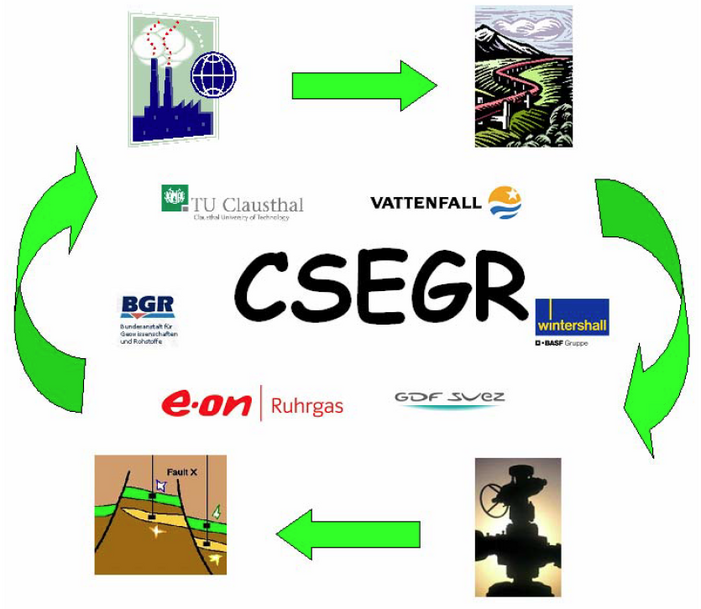
The German government aims at a 20% reduction of greenhouse gases until 2020. Even though Germany has achieved a remarkable reduction of CO2 emissions since 1990, annual reduction increments are declining. Globally, CO2 emissions are even increasing. Thus additional measures are needed to achieve the long-term reduction targets. According to the scientific advisory council of the federal government for global change (WBGU), underground storage of CO2 will be necessary to keep the effects of climate change within acceptable limits in the current century. The Bundesanstalt für Geowissenschaften und Rohstoffe (BGR) has compared different options for the underground storage of CO2 in Germany (May et al. 2003); accordingly gas fields would be the prime choice for CO2 storage. More than 50% of the gas reservoirs are already in a mature status and they are potential candidates for future CO2 storage. Injection of CO2 into depleted natural gas reservoirs could increase the reservoir pressure and enhance the recovery of the residual gas. This combination of CO2 storage and recovery enhancement (CO2-EGR or CSEGR = CO2 storage and enhanced gas recovery) is a theoretical concept still, that has not been practiced yet anywhere in the world.
This study shall investigate the feasibility of CSEGR for likely separation and storage systems (source–transport–sink) representing typical industrial sources and reservoir types in Germany. The proposed study will consider two systems for the technical evaluation of CO2-EGR feasibility:
- A large lignite fired power plant in East Germany emitting about 10 Mt of CO2 annually shall be the source of CO2 for EGR operations in heterogeneous, fine-scale structured, and anisotropic layered gas carrier rocks of the Rotliegend reservoirs in the Altmark. The Altmark would provide sufficient storage capacity for the CO2 emitted during the life-time of a large lignite fired power station.
- A homogeneous, large-scale structured, isotropic Buntsandstein gas reservoir in Northwestern Germany shall be used for EGR using CO2 separated at a planned industrial natural gas treatment facility emitting a few hundred thousand tons of CO2 annually. Data of the mature field Barrien will be used as an example, because this reservoir has been used previously already for enhanced recovery tests.
Within this feasibility study the geological, technical, and economical key parameters that will influence the optimisation of CSEGR will be investigated
The project contains three basic work packages (1-3) using industrial data to provide input to the central work packages. The CO2 sources are characterised and the requirements for CO2 transport and field distribution are defined in work package 1. In work package 2 the suitability of existing well technology for CO2-EGR will be investigated. Geological reservoir models will be built or updated in work package 3. In the main work packages (4-6) physical and chemical reactions induced by CO2 injection in the reservoir and the overburden will be investigated. Work package 4 focuses on CO2 induced hydrodynamic processes and on physical properties of CO2 and their incorporation into reservoir simulation modules. Information from natural analogues and reservoir rocks and fluids shall be used in work package 5 to identify geochemical reactions in reservoir and caprocks that are likely to occur during CO2-EGR. Predictive geochemical modelling shall be used to assess the potential impact of the identified reactions. It is internally structured in a way that much of the necessary input for simulation will be generated during the first year within the work package and additional information provided by work packages 1 and 2 on p-T conditions and impurities shall be available prior to the start of the reactive transport process simulations. While the process simulations in work packages 4 and 5 are more generic, reservoir simulations of CO2 injection and natural gas production from the two representative case studies will be performed in work package 6. In work package 7 all of the information will be compiled and serve as a base for the technical, economical and environmental feasibility study of the entire CCS-system.
Sponsors and partners
This project is a collaboration between the Federal Institute for Geosciences and Natural Resources (BGR), GDF SUEZ E&P Deutschland GmbH in Lingen, Wintershall AG, Vattenfall AB, and E.ON-Ruhrgas GmbH. The project was funded by the Federal Ministry of Education and Research (BMBF).