Deutsch
 English
Follow-up Report: Heat Transition Day
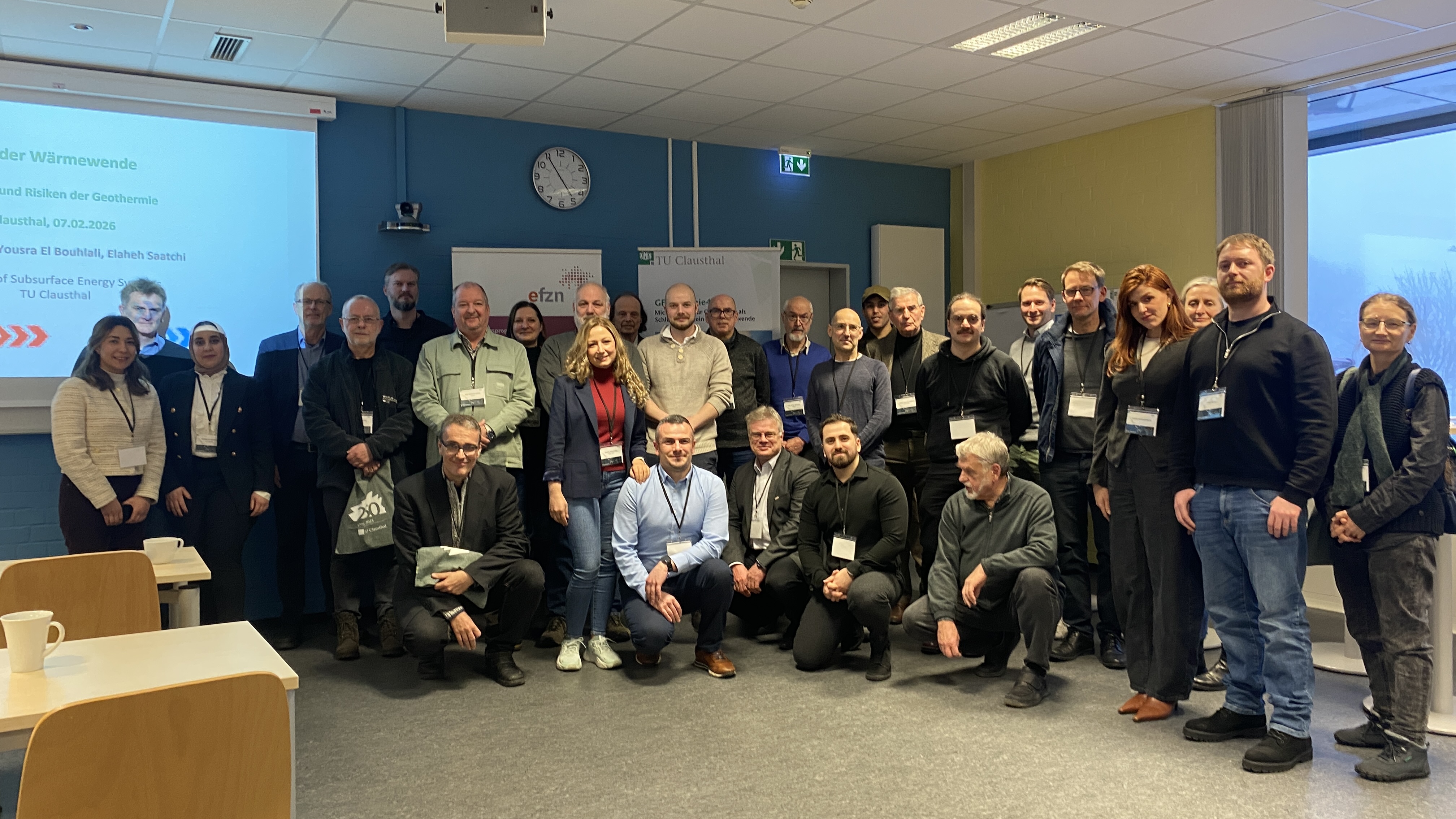
The Heat Transition Day at the Institute for Subsurface Energy Systems brought together experts from academia, industry, and local governments to discuss the technical, economic, and societal aspects of the energy transition.
On Saturday, February 7, the Institute for Subsurface Energy Systems (ITE) at Clausthal University of Technology hosted the Heat Transition Day. The event brought together researchers, industry representatives, business leaders, and local government officials to discuss current challenges, prospects, and potential solutions for the heat transition. A special focus was placed on taking a reflective look at the energy transition: in addition to technical issues, the economic, social, and political dimensions of the transformation were also discussed. The exchange between research and practice provided valuable impetus for future collaborations as well as for the further development of the institute’s continuing education programs.
The event kicked off with a keynote address by Prof. Philip Jaeger, who addressed the role of continuing education in the context of the energy transition. In this context, he presented two continuing education programs: Geothermie4All from Clausthal University of Technology and the Geoenergie 360° program, which is currently being developed in collaboration with the Lower Saxony Energy Research Center as part of the transformation of the energy system in Lower Saxony.
Yousra El Bouhlali presented an economic perspective on the heating transition; her master’s thesis focuses on the economic dimension of the heating transition. Her presentation highlighted, in particular, economic conditions, investment logic, and structural challenges in implementing such projects.
Sören Messinger-Zimmer from the Göttingen Institute for Sociological Research (SOFI) offered an interdisciplinary perspective on the social aspects of the energy transition. In his presentation, he posed the question “Is acceptance enough for us?” and discussed conflict dynamics as well as new approaches to ‘co-creation’ in the context of the energy transition.
Other presentations addressed the technical, economic, and political challenges of deep geothermal energy. Ingo Forstner from the German Association of Oil, Natural Gas, and Geoenergy (BVEG) provided insights into current developments from the industry’s perspective. Practical experiences from a municipal perspective were presented by Christian Vahlbruch. Finally, Prof. Lars Kühl from Ostfalia University of Applied Sciences presented strategies for integrating geothermal energy into municipal heat supply.
The event provided a forum for in-depth discussions, interdisciplinary exchange, and new connections between academia and industry. The insights gained will also inform the future development of the institute’s research and continuing education activities.
For more information and to register for our programs, visit: