Deutsch
 English

Integrity of completion systems for subsurface hydrogen storage
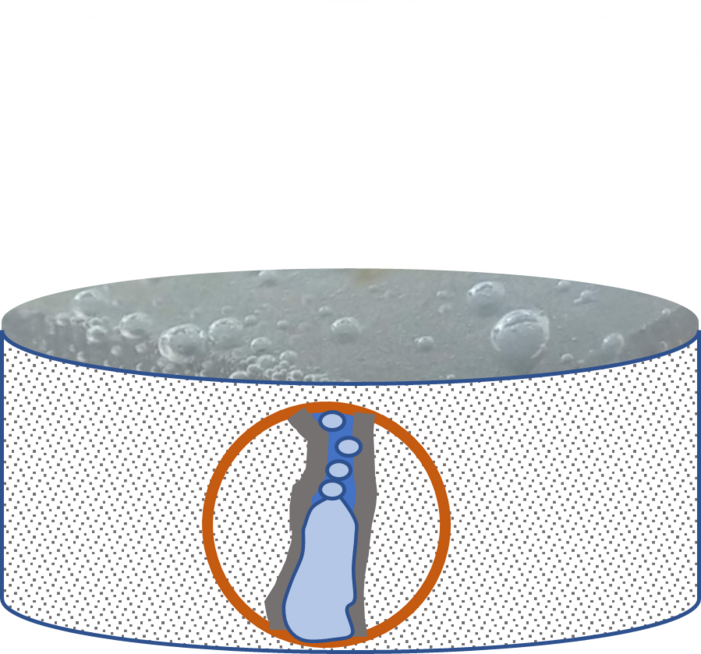
Objective of this project is to quantify the risks of storing hydrogen in underground storage facilities by better understanding the involved physical and chemical mechanisms and transport properties in porous systems. By means of laboratory tests, the effect of compressed hydrogen interacting with reservoir water inside the pores of the completion cement is experimentally studied, quantifying the relevant parameters in water-saturated cements under real reservoir conditions. Hydrogen diffuses rapidly in various materials, being partially stored in the microstructures, leading to changes that e.g. are known as hydrogen embrittlement in case of metals. Less is known about the behavior of hydrogen in cement, especially in the presence of formation water. Under reservoir conditions a fluid phase boundary develops, resulting in the formation of a capillary pressure, which in fine-pored systems can have high magnitudes which may contribute to the tightness of the system. The resulting capillary pressures are confirmed by determining the interfacial tension between the fluids and the contact angle formed in the pores under realistic operating conditions by the pendant and sessile drop measurement. The findings on the governing mechanisms along with data on the diffusivity of hydrogen inside the pores that are filled with formation water are used to estimate the loss of hydrogen by help of empirical correlations and numerical simulations.
Contact
Dr.-Ing. Nelson Perozo
Scientific Staff
Department:
Drilling and Production
Telephone: +49 5323 72 2288
Telefax: +49 5323 72 3146
E-Mail: nelson.perozo@tu-clausthal.de
ADDRESS
Institute of Subsurface Energy Systems
Agricolastraße 10
Building C 21, Room H104
38678 Clausthal-Zellerfeld