Deutsch
 English
Description
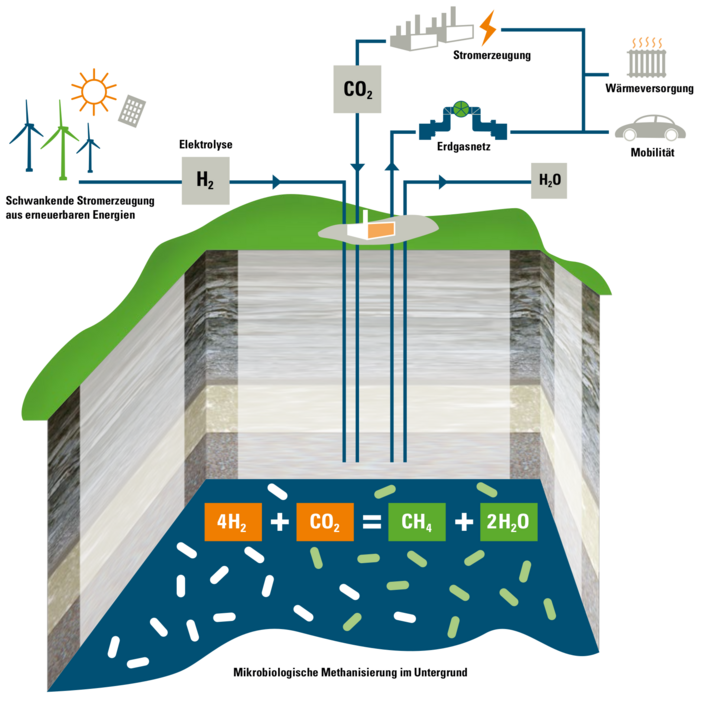
The project UMAS investigates the technical, economic and socio-economic feasibility as well as the ecological potential of underground methanation in aquifer storage. With the help of laboratory investigations and numerical modeling, the capacity for microbiological conversion is to be investigated or predicted and the geological integrity of the storage formation to be proven. The process engineering studies deal with the compatibility of existing plant components with the new storage media H2 and CO2. As a result, the development of a plant concept of the new plants to be supplemented for a technically safe underground methanation takes place. The economic viability of the project as well as the regional economic and economic effects are examined with regard to their interaction with the energy system under the focus of current and required market conditions for renewable gas and flexibility. A regional energy system model maps relevant electricity generators, consumers and the gas storage in its possible new function. The result of the project is the development of a technically and economically feasible overall concept for the extensive microbiological production of CH4 in the subsurface with the aim of providing the volatilities on the side of power generation with the much-needed flexibility.
Contact
Sponsors and partners
This project is a collaboration between DBI – Gas- und Umwelttechnik GmbH, the Institute for Ecological Economy Research GmbH, MicroPro GmbH, Berliner Erdgasspeicher GmbH, and the Reiner Lemoine Institute GmbH. The project is funded by the Federal Ministry for Economic Affairs and Energy (BMWi).