Deutsch
 English

Description
Polymer flooding is a method for mobility-controlled oil recovery from reservoirs. Due to its recovery mechanism, minimal equipment requirements, and relatively low costs, it is considered one of the low-risk and often economically attractive Enhanced Oil Recovery (EOR) methods. Understanding the nonlinear physical and chemical processes that govern polymer flooding plays a crucial role in the efficient design of polymer flooding projects. The goal of this project is to conduct a fundamental analysis of these processes using micromodels.
When examining the polymer flooding process, it is essential to understand the properties of the crude oil and the polymer solution, as well as the interactions between the fluids and between the fluids and the rock. The approach of using micro-models to study the polymer flooding process offers the opportunity to visualize and investigate in greater detail the wide variety of effects that play a role in polymer EOR.
Compared to flooding tests on cores, micro-models provide a detailed visual insight into the flooding process. This allows the local distribution of static and dynamic flow parameters to be observed on the model, which is intended to enable a fundamental investigation of the flooding process.
Current Phase 3
The final phase of the project aims to evaluate the application of the microfluidics developed in the first two phases to other areas, such as production optimization. Key research questions in this context include the stability of foams in porous media, the deposition of asphaltenes and their removal, and the filtration of drilling muds. In addition, the design and production of models will be further refined during the development of new chips with a permeability in the range of a few hundred millidarcy. In this process, the pore structure of a natural rock sample is mimicked, and its properties are transferred to a two-dimensional model. The results from the microfluidics experiments are validated using core flooding in the rock used for the design. Furthermore, methods are being developed to modify the internal surface, which initially exhibits water-wetting properties, through the adsorption of a self-assembled monolayer (SAM).
Previous project phases
Phase 1
Completed in 2014. This first phase of the project by the German Scientific Society for Petroleum, Natural Gas, and Coal (Deutsche Wissenschaftliche Gesellschaft für Erdöl, Erdgas und Kohle e.V.) was supported by ExxonMobil Production Deutschland GmbH, GDF SUEZ E&P Deutschland GmbH, RWE Dea AG, and Wintershall Holding GmbH.
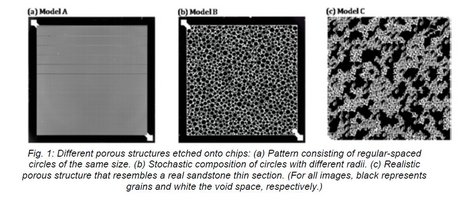
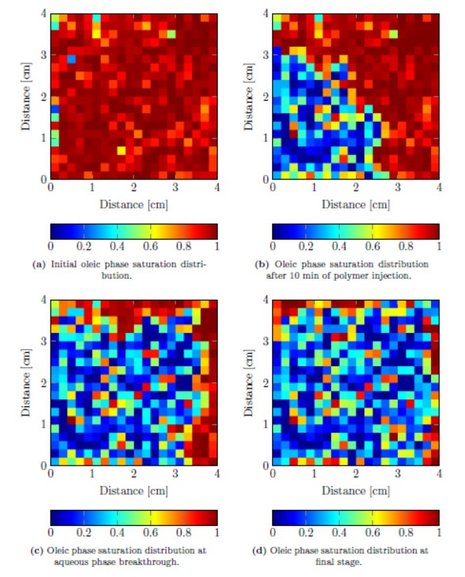
In the first phase of the project, proprietary micro-models were developed that offer several improvements over commercially available models. The models developed at ITE consist of a “sandwich” of two glass layers enclosing a porous layer of silicon. As a result, the models exhibit water-wetting surface properties similar to those of the sandstones found in many reservoirs. Furthermore, the models are resistant to most chemical influences and can withstand high temperatures and pressures. Artificial structures, as well as a realistic structure based on a thin section of a rock sample, served as porous structures. The flow across the square micromodel, which was designed based on a "quarter-to-five-spot" borehole pattern, enables the analysis of the efficiency of vertical displacement.
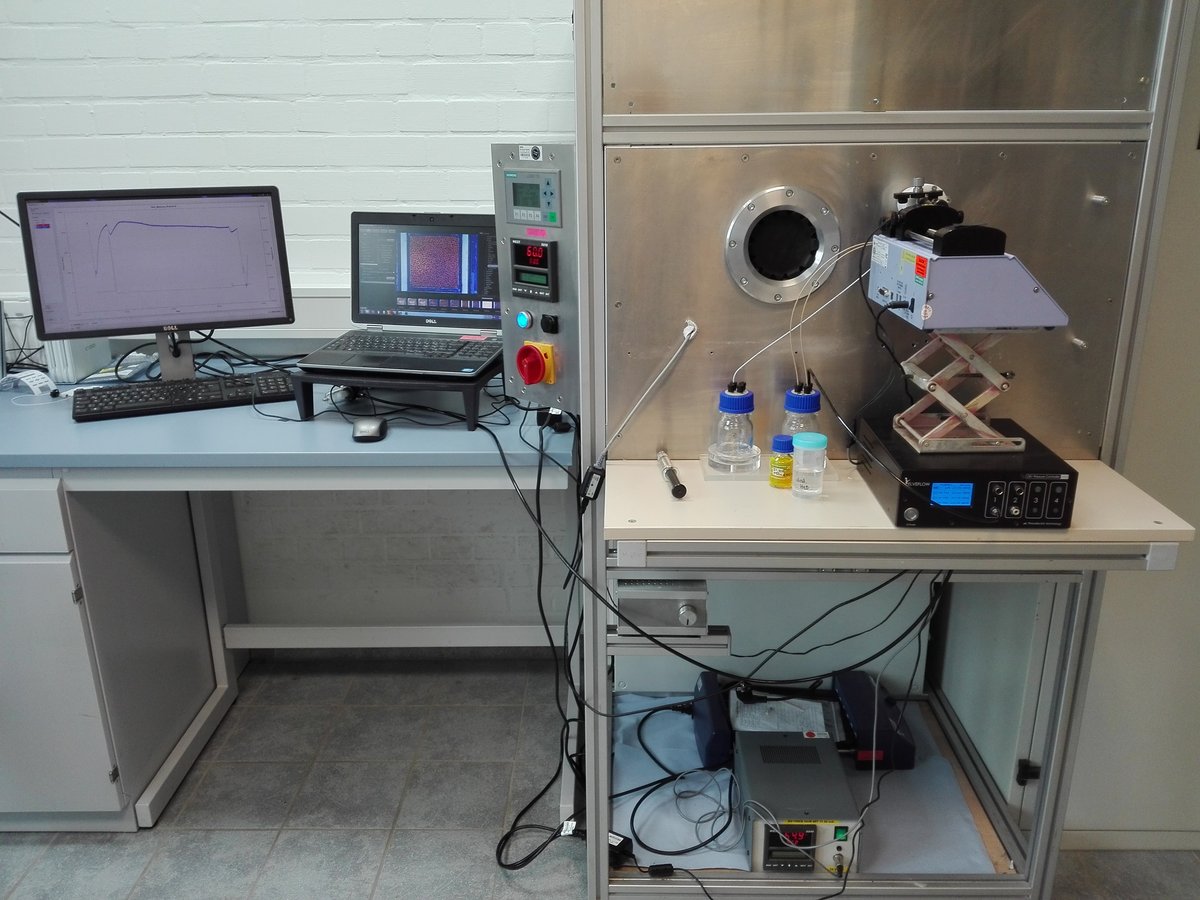
To conduct the experiments, an experimental setup including a model holder is designed to continuously record images of the porous structure and the flowing media, as well as the pressures before and after the model. The measured values and image data are automatically evaluated using algorithms that calculate the proportion of different fluids. A simulation toolbox also enables the numerical analysis of the experiments.
For the analysis of polymers, the rheology was determined for a selection of different products relevant to Enhanced Oil Recovery (EOR) at various concentrations, temperatures, and with different mixing waters of varying salinity and composition. The results were collected and organized in a database.
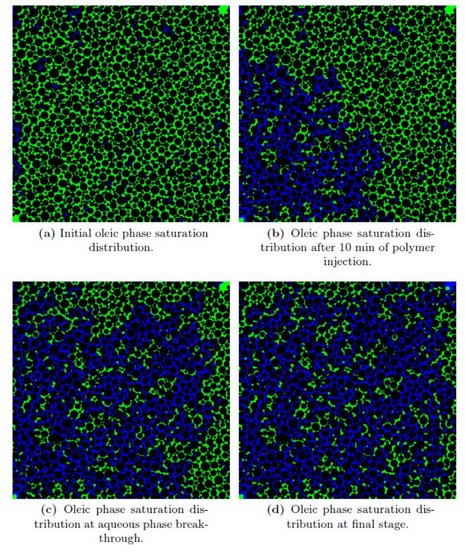
Following several single-phase experiments with Newtonian and non-Newtonian fluids, EOR experiments with polymers were conducted in secondary mode (polymer flooding in the oil-saturated model) or tertiary mode (polymer flooding following a water flooding experiment). The data obtained were used for the numerical analysis and simulation of flooding experiments in the micro-model.
Phase 2
Completed in 2017. This second phase of the project by the German Scientific Society for Petroleum, Natural Gas, and Coal (Deutsche Wissenschaftliche Gesellschaft für Erdöl, Erdgas und Kohle e.V.) was supported by ExxonMobil Production Deutschland GmbH, Neptune Energy Deutschland GmbH, DEA Deutsche Erdoel AG, and Wintershall Holding GmbH.
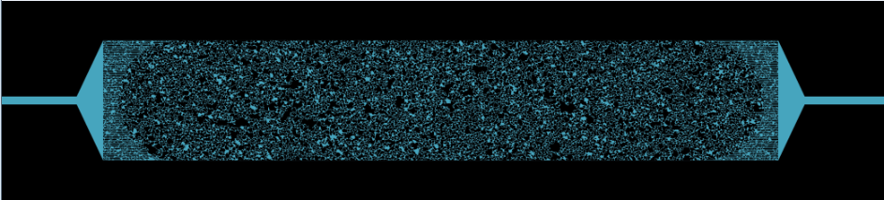
In the second phase of the project, the experimental setups were expanded to enable testing at high temperatures. A core flooding facility was constructed to compare the experimental results from the microfluidic tests. Flooding tests were conducted on Bentheim sandstone in this facility. To enable a comparison with the microfluidics, new chips were developed whose porous structure was derived from a µCT scan of Bentheim sandstone and whose porosity and permeability are comparable to those of real rock samples. Instead of the “quarter-to-a-five-spot” configuration, a linear geometry was chosen for the models to allow for a direct comparison with core flooding tests. In various single-phase and multiphase tests using micro-models, cores, and sand fillings, measurement data were collected and the results were replicated in the simulator. In addition, extended rheological investigations were conducted for biopolymer and HPAM solutions, including, in addition to standard rheology, oscillatory measurements and the determination of extensional viscosity.
In books and magazines
- Födisch H. 2019. Investigation of Chemical Enhanced Oil Recovery Core Flooding Processes with Special Focus on Rock-Fluid Interactions. Papierflieger Verlag, Clausthal-Zellerfeld. ISBN: 978-3-86948-697-0.
- Wegner J, Ganzer L. 2017. How Microfluidic Solutions Using a Rock-on-a-Chip Approach Look Set to Revolutionize IOR/EOR Process Visualization. Oilfield Technology Journal 7: pp. 15–18.
- Duffy J, Hincapie R. 2016. Using Rheology to Optimize the Performance of EOR Fluids. Oil and Gas Innovation Magazine 10: 42–43.
- Rock A, Hincapie R, Wegner J, Födisch H, Ganzer L. 2016. Pore-scale Visualization of Polymer Viscoelasticity Using Particle Tracing in Glass-Silicon-Glass Micromodels. EAGE First Break 34: DOI 10.3997/2214-4609.201600917.
- Födisch H, Hincapie R, Wegner J, Ganzer L. 2015. Visualization of connate water replacement during flooding experiments using Glass-Silicon-Glass micromodels. EAGE First Break 33: DOI: 10.3997/2214-4609.201412500.
- Hincapie R. 2016. Pore-Scale Investigation of the Viscoelastic Phenomenon during Enhanced Oil Recovery (EOR) Polymer Flooding through Porous Media. Papierflieger Verlag, Clausthal-Zellerfeld. ISBN: 978-3-86948-531-7.
- Wegner J. 2015. Investigation of Polymer Enhanced Oil Recovery (EOR) in Microfluidic Devices that Resemble Porous Media – An Experimental and Numerical Approach. Shaker Verlag, Aachen. ISBN: 978-3-8440-3520-9.
- Ganzer L, Wegner J, Buchebner M, 2014. Benefits and Opportunities of a “Rock-on-a-Chip” Approach to Access New Oil. OIL GAS-EUROPEAN MAGAZINE 39: pp. 43–47.
- Wegner J, Ganzer L. 2013. Numerical Analysis of Polymer Micro-Model Flooding Experiments. In Proceedings of the 3rd Sino-German Conference “Underground Storage of CO2 and Energy,” Goslar, May 21–23, 2013, (eds. Hou MZ, Xie H, Were P), pp. 131–142. Springer-Verlag, Berlin Heidelberg.
Conference Proceedings and Conferences
- Tahir M, Hincapie R E, Gaol C, Säfken S, Ganzer L. 2020. Describing the Flow Behavior of Smart Water in Micromodels with Wettability-Modified Pore Structures. Society of Petroleum Engineers. DOI: 10.2118/198948-MS.
- Säfken S, Wegner J, Ganzer L. 2019. Wettability Alteration of Microfluidic Rock-on-a-Chip Devices to Replicate Reservoir Conditions. In DGMK Conference Proceedings 2019-1, pp. 461–468. German Society for Petroleum and Coal Science and Technology, Hamburg.
- Hincapie RE, Rock A, Wegner J, Ganzer L. 2017. Oil Mobilization by Viscoelastic Flow Instabilities Effects during Polymer EOR: A Pore-scale Visualization Approach. Society of Petroleum Engineers. DOI: 10.2118/185489-MS.
- Rock A, Hincapie RE, Wegner J, Ganzer L. 2017. Rock-on-a-Chip Devices for High p, T Conditions and Wettability Control for the Screening of EOR Chemicals. 79th EAGE Annual Conference & Exhibition. DOI: doi.org/10.2118/185820-MS.
- Wegner J, Ganzer L. 2017. Advanced Flow Behavior Characterization of Enhanced Oil Recovery Polymers. 79th EAGE Annual Conference & Exhibition. DOI: 10.2118/185814-MS.
- Be M, Hincapie RE, Rock A, Gaol CL, Tahir M, Ganzer L. 2017. Comprehensive Evaluation of the EOR Polymer Viscoelastic Phenomenon at Low Reynolds Number. 79th EAGE Annual Conference & Exhibition. DOI: 10.2118/185827-MS.
- Tahir M, Hincapie RE, Be M, Ganzer L. 2017. Experimental Evaluation of Polymer Viscoelasticity during Flow in Porous Media: Elongational and Shear Analysis. 79th EAGE Annual Conference & Exhibition. DOI: 10.2118/185823-MS.
- Rock A, Hincapie RE, Wegner J, Födisch H, Ganzer L. 2017. Pore-scale Visualization of Oil Recovery by Viscoelastic Flow Instabilities during Polymer EOR. 19th European Symposium on Improved Oil Recovery. DOI: 10.3997/2214-4609.201700273.
- Hauhs F, Födisch H, Hincapie R, Ganzer L. 2017. Novel Application of Foam and Air Flooding in Glass-Silicon-Glass Micromodels. In DGMK Conference Proceedings 2017-1, pp. 249-259. German Society for Petroleum and Coal Science and Technology, Hamburg.
- Rock A, Hincapie RE, Wegner J, Ganzer L. 2017. Advanced Flow Analysis of Viscoelastic EOR Polymers in Porous-Media-Resembling Micromodels. In DGMK Conference Proceedings 2017-1, pp. 485–492. German Society for Petroleum and Coal Science and Technology, Hamburg.
- Gaol CL, Wegner J, Ganzer L. 2017. A New Approach to Micromodel Construction Based on X-ray Micro-computed Tomography (µCT) from Core Plugs. In DGMK Conference Proceedings 2017-1, pp. 239–247. German Society for Petroleum and Coal Science and Technology, Hamburg.
- Elhajjaji RR, Hincapie RE, Tahir M, Rock A, Wegner J, Ganzer L. 2016. Systematic Study of Viscoelastic Properties during Polymer-Surfactant Flooding in Porous Media. Society of Petroleum Engineers. DOI:10.2118/181916-RU.
- Rock A, Hincapie R, Wegner J, Födisch H, Ganzer L. 2016. Pore-scale Visualization of Polymer Viscoelasticity Using Particle Tracing in Glass-Silicon-Glass Micromodels. 78th EAGE Conference and Exhibition. DOI: 10.3997/2214-4609.201600917.
- Elhajjaji RR, Hincapie R, Ganzer L. 2016. Evaluation of Viscoelastic Behavior during Surfactant-polymer Flooding in Porous Media Using Microfluidics. 78th EAGE Conference and Exhibition. DOI: 10.3997/2214-4609.201600918.
- Födisch H, Wegner J, Hincapie RE, Ganzer L. 2015. Impact of Connate Water Replacement on Chemical EOR Processes. Society of Petroleum Engineers. DOI: 10.2118/177196-MS.
- Hincapie RE, Duffy J, O'Grady C, Ganzer L. 2015. An Approach to Determine Polymer Viscoelasticity under Flow through Porous Media by Combining Complementary Rheological Techniques. Society of Petroleum Engineers. DOI: 10.2118/174689-MS.
- Wegner J, Hincapie RE, Foedisch H, Ganzer L. 2015. Novel Visualization of Chemical EOR Flooding Using a Lab-on-a-Chip Setup Supported by an Extensive Rheological Characterization. Society of Petroleum Engineers. DOI: 10.2118/174648-MS.
- Hincapie R, Ganzer L. 2015. Assessment of Polymer Injectivity with Regards to Viscoelasticity: Lab Evaluations towards Better Field Operations. Society of Petroleum Engineers. DOI: 10.2118/174346-MS.
- Födisch H, Hincapie R, Wegner J, Ganzer L. 2015. Visualization of Connate Water Replacement during Flooding Experiments Using Glass-Silicon-Glass Micromodels. 77th EAGE Conference and Exhibition in Madrid. DOI: 10.3997/2214-4609.201412500.
- Muhammad T, Hincapie R. 2015. Coexistence of Shear and Elongational Components of Flow Paths through Porous Media during Polymer-Flooding Applications. 77th EAGE Conference and Exhibition. DOI: 10.3997/2214-4609.201412503.
- Hincapie RE, Duffy J, O'Grady C, Ganzer L. 2015. Using DLS Microrheology, Rotational Rheometry, and Microfluidics to Better Understand the Behavior of Polymeric Materials for Use in Enhanced Oil Recovery Applications. 10th Annual European Rheology Conference.
- Muhammad T, Hincapie R. 2015. An Experimental Approach to Analyze Polymer Mechanical Properties. International Student Petroleum Congress & Career Expo.
- Romero JA, Hincapie R. 2015. Sand Pack Processing for Polymer Flooding Injectivity Purposes: Workflow and Experimental Set-Up. International Student Petroleum Congress & Career Expo.
- Herbas J, Wegner J, Hincapie R, Ganzer L. 2015. Comprehensive Micromodel Study to Evaluate Polymer EOR in Unconsolidated Sand Reservoirs. 19th Middle East Oil & Gas Show and Conference. DOI: 10.2118/172669-MS.
- Ganzer L., Wegner J, Buchebner M. 2014. Benefits and Opportunities of a “Rock-on-a-Chip” Approach to Access New Oil. In DGMK Conference Proceedings 2014-1, pp. 385-394. German Society for Petroleum and Coal Science and Technology, Hamburg.
- Qi M, Wegner J, Falco L, Ganzer L. 2013. Pore-Scale Simulation of Viscoelastic Polymer Flow using a Stabilized Finite Element Method. Society of Petroleum Engineers. DOI: 10.2118/165987-MS.
- Qi M, Wegner J, Ganzer L. 2013. Numerical Study of Viscoelastic Polymer Flow in Simplified Pore Structures using a Stabilized Finite Element Model. In DGMK Conference Proceedings 2013-1, pp. 453–462. German Society for Petroleum and Coal Science and Technology, Hamburg.
- Zheng S, Hincapie R, Ganzer L. 2013. Laboratory and Simulation Approach to the Polymer EOR Evaluation in German Reservoir Characteristics. DGMK Conference Proceedings 2013-1, pp. 431–440. German Society for Petroleum and Coal Science and Technology, Hamburg.
- Kouchaki S, Hincapie R, Ganzer L. 2013. Rheological Evaluation of Polymers for EOR: Proper Procedures for a Laboratory Approach. DGMK Conference Proceedings 2013-1, pp. 367–378. German Society for Petroleum and Coal Science and Technology, Hamburg.
- Födisch H, Wegner J, Hincapie-Reina R, Ganzer L. 2013. Characterization of Glass Filter Micromodels Used for Polymer EOR Flooding Experiments. In DGMK Conference Proceedings 2013-1, pp. 325–334. German Society for Petroleum and Coal Science and Technology, Hamburg.
- Hincapie R, Wegner J, Buchebner M, Zheng S, Ganzer L. 2012. Laboratory Investigation of Parameters Affecting Viscosity of Enhanced Oil Recovery Polymers. In DGMK Conference Proceedings 2012-2, pp. 495–500. German Society for Petroleum and Coal Science and Technology, Hamburg.
- Wegner J, Ganzer L. 2012. Numerical Simulation of Oil Recovery by Polymer Injection Using COMSOL. COMSOL Conference 2012.
- Hincapie R, Wegner J, Buchebner M, Ganzer L. 2012. Experimental Setup and Workflow for Polymer Flooding Processes Using Micromodels. In DGMK Conference Proceedings 2012-2, pp. 501–504. German Society for Petroleum and Coal Science and Technology, Hamburg.
- Wegner J, Buchebner M, Hincapie R, Ganzer L. 2012. Development of a Numerical Polymer EOR Toolbox to Facilitate the Design and Interpretation of Micromodel Flooding Experiments. In DGMK Conference Proceedings 2012-2, pp. 505–514. German Society for Petroleum and Coal Science and Technology, Hamburg.